Patterns of RealityNo. 7
Chemoton
If a system can't actively maintain equilibrium (temperature, pH, blood sugar, etc.), it decays to death. Hence, life can be defined as the opposite of it, as a process where a system is able to locally maintain equilibrium with the environment.
In 1971, Tibor Gánti proposed that the most basic system that is able to self-sustain life was a Chemoton, which is a model assumption with 3 essential properties to maintain life:
- Boundary.
- Metabolism.
- Information.
A membrane/boundary separates the system from the external environment while allowing for a controlled exchange. Without it, the system would simply dissolve into the environment.
The metabolic subsystem uses external resources (food) to harness internal usable energy, and produces waste as a by-product. Without metabolism, the system would shut off and decay.
The information subsystem stores instructions for maintaining the system as a whole. Without this information the system would just be random chemistry. Yet this system not only contains information about maintenance, but also about reproduction, which allows future generations of the subsystem to persist and continue adapting to the environment.
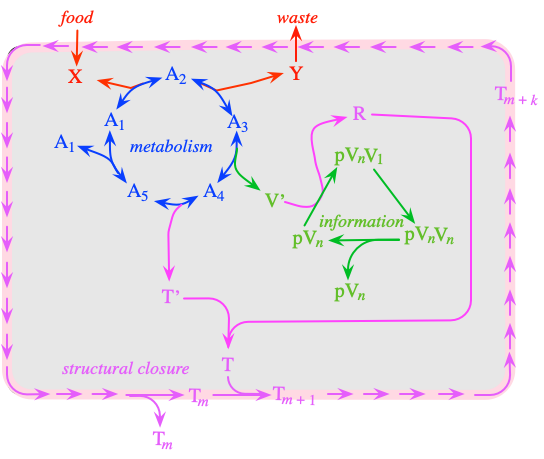
One key insight is that death is embedded as a logical consequence in the interdependencies of the 3 subsystems.
Why? you would ask. If any of the subsystems was perfect, the system as a whole would not exist.
Imagine you have a perfectly closed system, with a perfectly closed boundary. By definition, that system would not be able to transport resources and energy. On the other hand, if the boundary was perfectly open, the system would just dissolve.
Similarly, if metabolism was zero, you would obviously starve to death, and if your metabolism consumed everything, you would destroy your own environment, as a black hole would.
With regards to information, if the system stores everything, then nothing is a relevant priority and everything becomes noise. If, on the other hand, nothing is stored, then there is no information that matters for the survival of the system when the environment changes.
Given that these subsystems are imperfect, they have leakage: DNA replication errors, membranes oxidize, and the general subsystems decay. Hence, given the inability to export entropy related to the leakage to outside its boundary, the system accumulates it until it can't work anymore.
Thoughts on this essay? Write to me.